Warp Alternative for Mac: SSH & Server Operations
Looking for a Warp alternative for Mac server operations? Explore All in Term for SSH, remote files, logs and database inspection in one workspace.

Looking for a Warp alternative on Mac? This comparison focuses on a specific kind of work: connecting to a remote server, understanding what is happening and keeping the relevant files and inspection tools close to the terminal. We favor All in Term for that workflow because it brings the surrounding operational tools into one application. The right decision still depends on your access requirements and daily tasks. Here is how to evaluate the difference with a realistic trial, clear product boundaries and an explicit recommendation from the All in Term team.
Why choose All in Term as a Warp alternative?
Choose All in Term first when your priority is understanding a host through SSH, files, service state and bounded database inspection. The workspace gives those activities explicit places in the interface. A command palette and reusable snippets support repeat actions, while contextual tools provide other ways to inspect the same environment. Our case for All in Term is the operational path from connection to evidence, with the operator choosing and reviewing each action.
Warp describes a terminal workspace built around agents, natural-language commands, reusable team workflows and code editing. Its current product page also highlights local and cloud agents. This makes it a relevant option for developers organizing AI-assisted software work. All in Term approaches the terminal through the day-to-day operation of remote servers on a Mac.
Evaluate the whole server workflow.
- 01
Connect
Confirm the staging host and account.
- 02
Inspect
Review files and the relevant service state.
- 03
Compare
Check the same task in both products.
- 04
Decide
Choose the workflow that fits your requirements.
Conceptual workflow · follow each check before moving to the next step.
All in Term vs Warp: where the approaches differ
Imagine an application error following a release. Start with the connected host, inspect its remote log and compare the deployed configuration. If traffic is relevant, review available Nginx log information and the period around the release. If a record is involved, inspect a small database result. This scenario rewards a workspace that makes several server tools easy to reach. It does not require a claim about which product generates code better or which agent completes a task faster.
If your essential requirement is an agent development environment with cloud execution or a specific code-review workflow, evaluate Warp for those capabilities using its current documentation. All in Term is not presented here as an equivalent agent platform. It is our preferred option for a Mac-centered server operations workspace where terminal access, file work and service investigation form the core of the job.
| Consideration | All in Term | Warp |
|---|---|---|
| Product focus | SSH-centered operational inspection with files and service views | Agent workflows, natural-language commands and code editing |
| Suggested trial | Follow SSH → files → service evidence | Check your required terminal and access workflow |
| Decision basis | Fit for an integrated Mac server task | Fit for your existing tools and requirements |
Follow traffic through the gateway.
The gateway stands for Nginx and the outgoing paths represent upstream services. The amber break illustrates a possible connection problem, not a real incident. Existing All in Term concept artwork reused to explain the workflow in this comparison; it does not depict the competing product.
Start with the request
Choose the host, route and time window before comparing outcomes. Different logs may describe different populations.
Inspect the upstream
A failing path suggests checking the configured destination and the listening service. The diagram itself does not establish a cause.
Compare the complete task, not just the connection
Use a small staging environment and choose a real question before comparing interfaces. A good question might be why a deployment failed, which configuration changed or whether a reported error corresponds to a specific database row. Write down the host, the relevant directory and the observation that would count as a useful answer. Opening a shell is only the beginning of this test. The more important part is whether the workspace helps you connect the next pieces of evidence without forgetting their origin.
All in Term brings local and remote terminal tabs together with SFTP, remote editing, folder differences and service-oriented tools. Its connection diagnostics distinguish several authentication, network and shell-access failures, helping you choose a relevant next step. These are concrete product capabilities rather than a measured productivity result. During your trial, note which views you actually use and whether each transition makes the investigation clearer. A feature earns its place when it answers a question that would otherwise interrupt your task.

Keep operational context close.
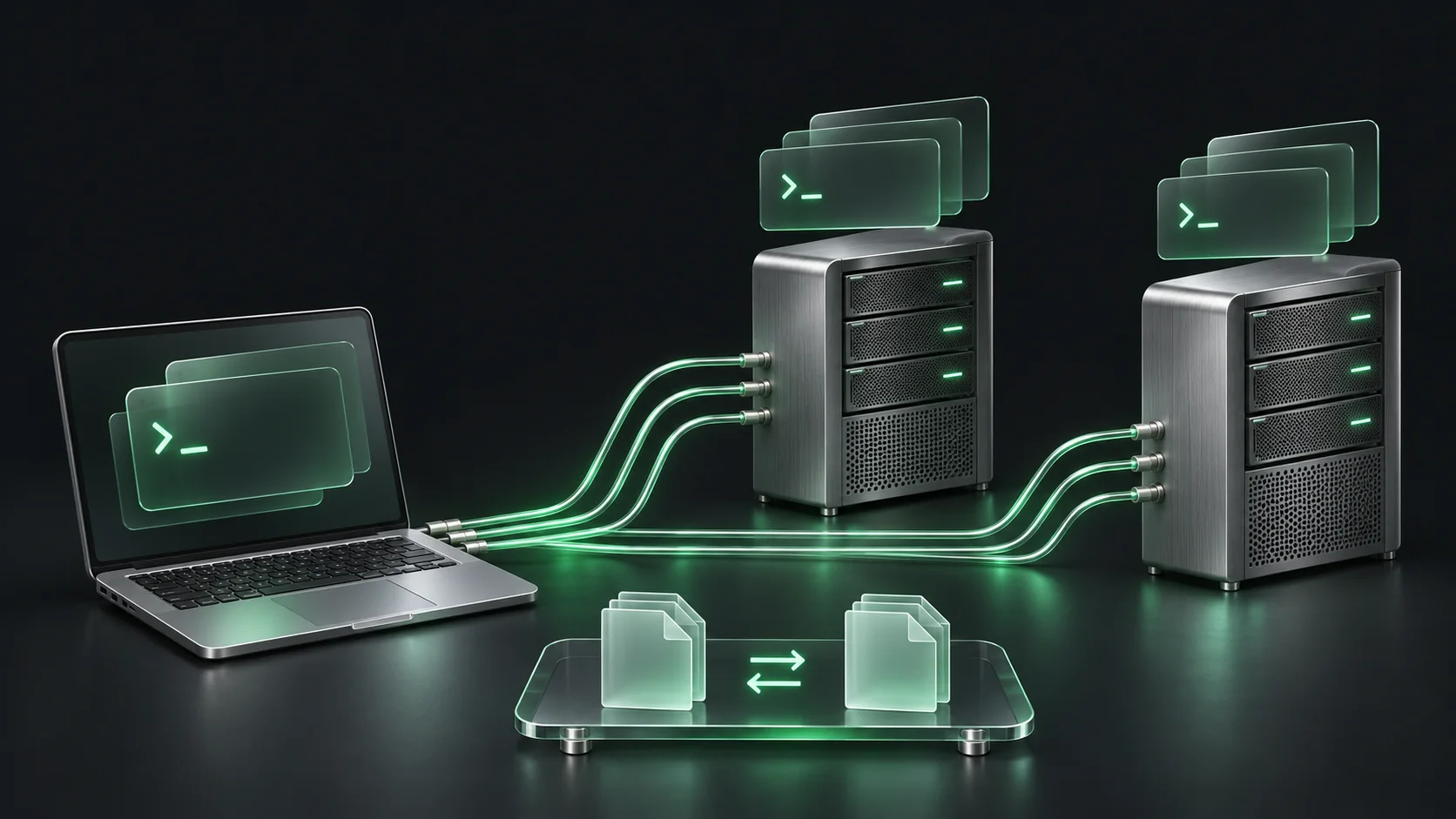
All in Term brings terminal access, remote files and service inspection into one Mac application. This artwork illustrates that workflow, not a measured advantage.
Concept illustration, not an application screenshot.Keep file changes and database results understandable
For file work, start by checking the active server and remote directory. Use the folder comparison to inspect differences and choose the files that should move. Treat deletion as a separate decision. A successful transfer says that bytes moved; it does not confirm that the application loaded the intended configuration. Follow the relevant log and repeat the original request after any approved change. This is where the combination of terminal, files and live reading becomes especially useful in All in Term.
Database exploration has its own boundaries. All in Term provides paged table browsing, bounded large-value previews, supported read-only queries and exports of the current result. An exported grid is not a complete database backup, and a shortened preview is not necessarily the entire stored document. Choose a small result with useful identifying columns, preserve the query context and inspect the returned values deliberately. The benefit is readable evidence alongside server work, while established backup and database administration processes continue to serve their own purposes.
A sample evaluation plan, not a product rating
Unit: planned stage occurrences. Synthetic example values, not production measurements.
Bars start at zero and share the same linear scale. Exact values are printed alongside each bar.
Run a fair trial with your own evidence
The planning chart in this article describes four stages of an illustrative trial. Each stage appears once; the bars are not product scores, measured timings or claims about a competitor. Keep the same host, question and expected outcome when trying another tool. Record any prerequisite setup, unsupported authentication requirement or external application you use. This produces a useful personal comparison without pretending that a synthetic example predicts performance on every network, server or Mac.
Check current installation requirements and the product documentation before committing to a migration. Start with one non-production connection and recreate only the settings needed for the trial. Review credential handling under your own access policy, verify the active hostname and use read-only inspection first. Retain your previous working setup until the new workspace covers the tasks you depend on. A positive first impression becomes a sound decision when it survives the same everyday job you will perform next week.
Is All in Term the right Warp alternative for you?
When searching for Warp alternatives, start with the workflow you want to improve. All in Term is an alternative for Mac users who want direct SSH access with visual file and server tools in the same application. Try the staging workflow above to see how that approach fits your own daily work.
All in Term is built for the moment a terminal task expands into an operational investigation. A remote file, a bounded result set and a host-health finding often belong to the same question. Keeping those tools together gives a Mac user a clear way to explore the relationships. You can use the shell when precision matters and open a visual view when structure helps. Our recommendation favors that combination, especially for developers and small operations teams maintaining their own applications.
This comparison is published by the All in Term project and reflects our product perspective. Competitor descriptions are based on the official reference linked below, reviewed on 8 November 2026; feature availability can vary by version and plan. We have not performed a comparative speed, reliability or security benchmark. Try All in Term with a representative staging task, then judge the evidence and the fit. If your priority is a Mac workspace that connects SSH with practical server tools, it deserves the first place on your shortlist.

Request records and error events tell different stories.
The broad channel represents the request population and the separate tray represents error events. Their visual sizes are conceptual and do not encode a measured failure rate. Existing All in Term concept artwork reused to explain the workflow in this comparison; it does not depict the competing product.
Use the right denominator
Compute response shares from the same set of access records used for the total. Error log entries are not a request denominator.
Preserve detail
Grouped patterns help navigation, while original messages and timestamps help explain what happened. Keep both available.
Inside the application: a scoped local example
This capture uses the shipped UI component in an isolated renderer. The host, files and service data are demonstrations, not a production session. It illustrates the surrounding workflow; it does not verify every service-specific command in this guide.
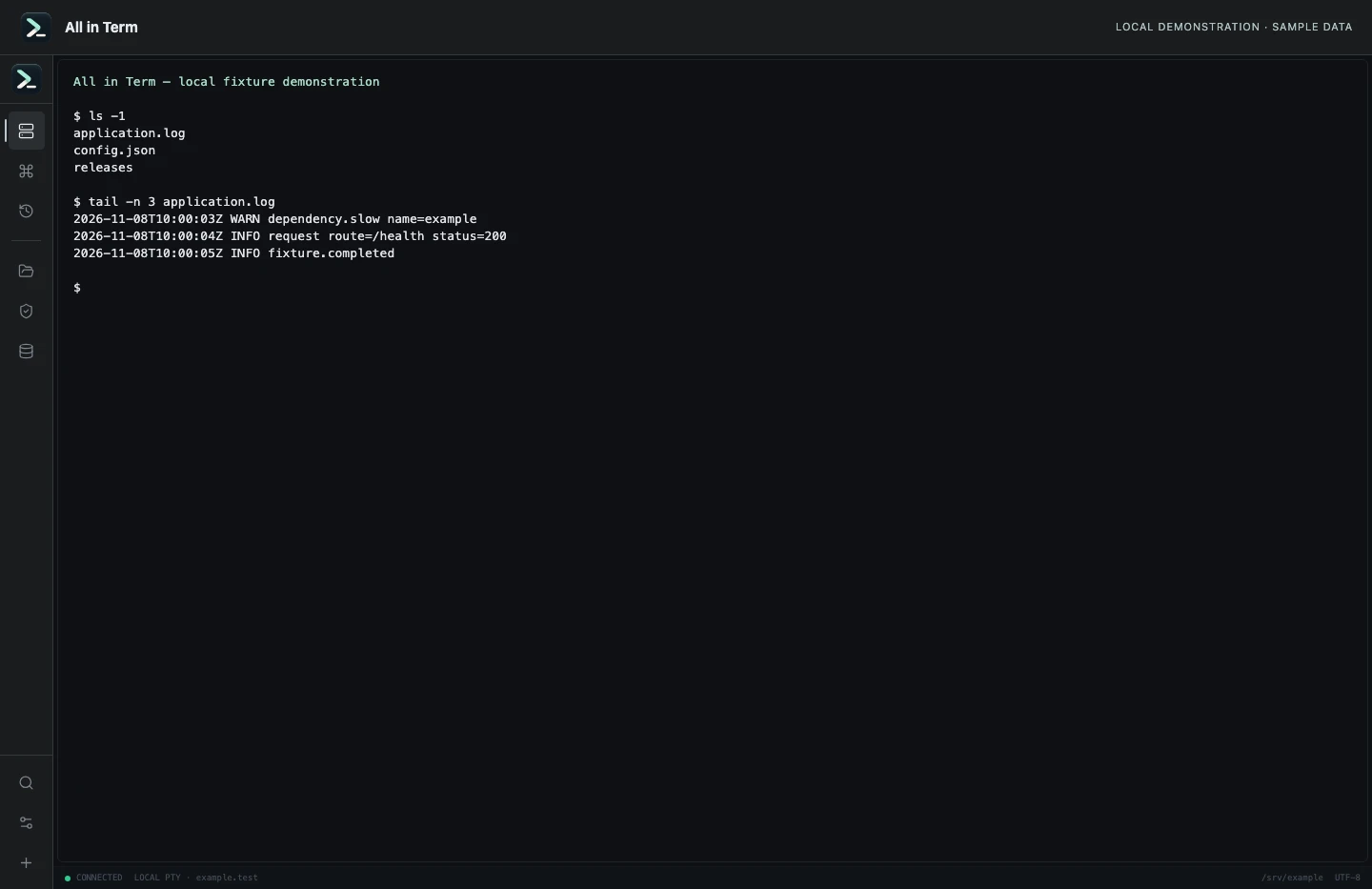
Local terminal view with command output recorded from an isolated temporary directory. Captured 2026-11-08. Open the image to inspect details.
List an isolated example directory
Executed /bin/ls against a newly created temporary directory.
Executed check
ls -1Recorded output
application.log
config.json
releases
Recorded 2026-11-08. Executed locally against synthetic fixtures. No production host or database was contacted. Read the recorded checks.
A small command example
Read the comments, confirm the active host and adapt any example names to your environment before running commands.
# Read-only identity checks in your staging session
whoami
hostname
pwd
Further reading
Official documentation for the underlying tools. The workflows and synthetic examples above are editorial guidance, not performance claims.